
More Info
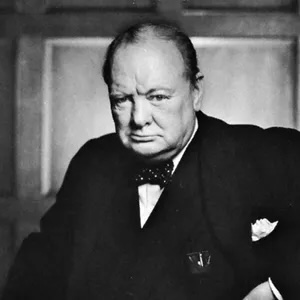
Winston Churchill was the most gifted political leader of the twentieth century, and arguably the greatest Briton since Shakespeare. This class will not attempt to provide a linear, chronological account of the phases of his long and multifaceted career, but rather to examine four aspects of his greatness over more than half a century of public service: as politician, writer, spymaster, and strategist.
The Politician. Gilbert and Sullivan’s Iolanthe (1882) famously satirized British politics by stating that every child born alive is “either a little Liberal / Or else a little Conservative,” mocking the entrenched two-party system. Winston Churchill’s father Randolph Churchill was a famous leader of the Conservatives, and young Winston began his career with them. But he broke with the Conservatives in 1904 over the issue of Free Trade and spent twenty years as a leading statesman among the Liberals. And then, despite his return to the Conservative fold during the 1920s, he found himself excluded from one Conservative government after another during the crucial decade of the 1930s: his “wilderness years,” when he opposed the policy of appeasement. Why was the greatest British political of the modern era so widely admired, and yet so bitterly distrusted, by his contemporaries?
The Writer. Churchill published an estimated 13 million words in 80 volumes over the course of his long life—more than William Shakespeare and Charles Dickens combined. And in 1953, he received the Nobel Prize for Literature “for his mastery of historical and biographical description as well as for brilliant oratory in defending exalted human values.” But his writing was not only a contribution to literature, it was also a lifeline, the principal source of his income: in some years, his income from his writing exceeded his government salary by a factor of ten. How did he write so much, and so well? What were the sources of his greatness as a writer, orator, and historian?
The Spymaster. Churchill’s fascination with the uses of intelligence extends back to his experiences in Britain’s imperialist wars of the late nineteenth century. He was one of the chief founders of Britain’s modern intelligence services during the years before the First World War, made use of private intelligence briefings during the 1930s to provide ammunition for his sustained critique of the policies of disarmament and appeasement, and presided over the most successful coup in the history of war during the 1940s: the development of the astoundingly successful codebreaking operation at Bletchley Park during WWII. How did Churchill use intelligence as a “force multiplier” and a means of bonding with his great partner, that other “man of secrets,” FDR, during the struggle to defeat Hitler?
The Strategist. Churchill joined the British Army in 1895 and saw action in British India, the Mahdist war in Sudan, and the Second Boer War, gaining fame as a war correspondent and publishing four books about his campaigns by the age of 25. With the exception of Napoleon Bonaparte, no politician in modern European history had more military experience and devoted more time and energy to the study of military affairs than Winston Churchill. But how effective was he as a grand strategist during the era of the two world wars? His career was nearly destroyed by the failure of his Dardanelles campaign during the First World War, and his own generals chafed under his leadership during WWII, vigorously contesting his strategic initiatives and his tactical blunders. Nevertheless, he had a strategic vision steeped in his study of history, honed not only by his own military experience, but also that of his distinguished ancestor, Lord John Russell, Duke of Marlborough (1650-1722), whose brilliant military career established Britain as a great power—a status Winston Churchill devoted his efforts to sustaining over the course of the twentieth century.
PRESENTER:
Bruce Thompson, Ph.D., is a lecturer in the Departments of History and Literature and the Associate Director of Jewish Studies at U.C.-Santa Cruz and also teaches at the Institute. He received his Ph.D. in History from Stanford; his areas of scholarly research include European intellectual and cultural history, French history, British Isles history, American Jewish intellectual and cultural history, the history of cinema, and the history of espionage.